EU CATCH & IUU Rules for Squid & Octopus Buyers (2026)
EU CATCH & IUU Documentation: What Squid and Octopus Importers Need in 2026
Key takeaways
- The EU's digital CATCH system became mandatory on 10 January 2026 for all fishery-product imports, replacing the old paper-based catch certificate regime under the revised IUU Regulation.
- Wild-caught species such as squid, octopus, and cuttlefish are directly affected — every consignment now needs a valid, fully completed digital catch certificate submitted through CATCH in TRACES NT.
- Since the transitional grace period for new data fields ended on 10 July 2026, incomplete documentation can trigger customs holds, rejection, or return to origin.
- The most reliable way to avoid border problems is to source from a single, traceable, certified supplier that can produce complete catch and processing documentation for every lot.
If you import squid or octopus into the European Union, 2026 has changed the rules of the game. Catch documentation is no longer a formality handled at the border — it is now a digital, end-to-end requirement that determines whether your container clears customs or sits in a holding bay accruing costs.
This guide explains what the EU CATCH system is, which documents your squid and octopus shipments need, why Vietnamese wild-caught cephalopods sit inside the IUU framework, and how to protect your supply chain by choosing the right sourcing partner.
What is the EU CATCH system? (Quick definition)
The EU CATCH system is the European Union's mandatory digital platform for submitting and verifying catch certificates for wild-caught fishery products imported into the EU. It operates inside TRACES NT (the EU's online trade-control platform) and became compulsory on 10 January 2026, replacing decades of paper-based catch certificates under the EU's Illegal, Unreported and Unregulated (IUU) Fishing Regulation.
In plain terms: before a wild-caught seafood shipment can enter the EU, the importer must create, validate, and submit a digital catch certificate — plus any processing statements — through CATCH. Paper documents are no longer accepted on their own; where an exporting country still issues paper certificates, the data must be entered manually into the system.
Seafood makes up roughly 70% of EU consumption, and about 80% of those imports fall under the IUU Regulation — which is why CATCH is one of the most consequential traceability changes in global seafood trade this decade.
[ European Commission — official CATCH / IUU Regulation page]
Why squid and octopus are squarely in scope
The IUU Regulation applies to wild-caught marine species. Squid (including Loligo and Todarodes), octopus, and cuttlefish are all harvested from capture fisheries — not farmed — so every commercial import of these products into the EU requires catch documentation.
This is different from farmed species like pangasius or vannamei shrimp, which are covered by aquaculture and health rules rather than catch certificates. For a buyer whose portfolio includes cephalopods, that means IUU compliance is not optional background paperwork — it is a core condition of doing business.
For Vietnamese-origin product specifically, there is an added layer: Vietnam has been under the European Commission's IUU "yellow card" since 2017. Throughout 2026, Vietnam has run intensive compliance drives — including a high-intensity enforcement month from 15 August to 15 September 2026, with results compiled and submitted to the European Commission before 1 October 2026 ahead of a further EC inspection. The direction of travel is clear: traceability requirements are tightening, not loosening.
“See our latest squid and octopus product guides”
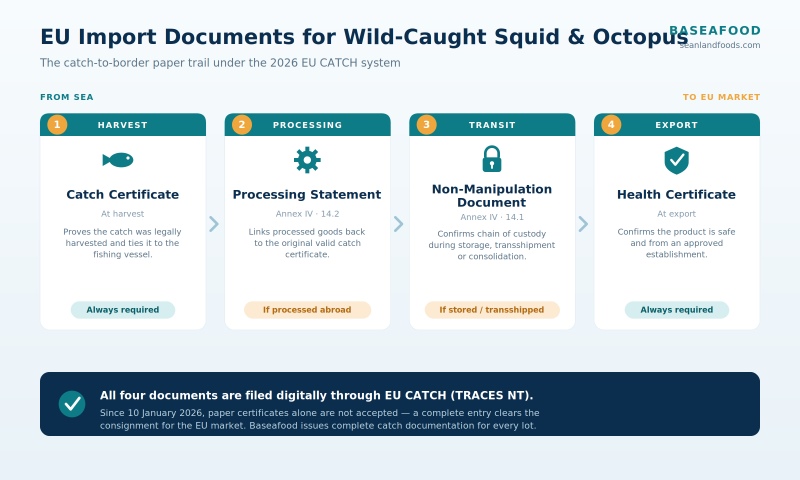
The documents your shipment needs
Wild-caught cephalopod consignments entering the EU generally rely on the following documentation. The exact set depends on whether the product was processed and where.
| Document | When it's required | What it proves |
|---|---|---|
| Catch Certificate | Every wild-caught consignment | The catch was legally harvested and links product to the harvesting vessel(s) |
| Processing Statement (Annex IV 14.2) | Product processed in a non-EU country before export | Processed goods trace back to a valid catch certificate |
| Non-Manipulation Document (Annex IV 14.1) | Product stored, transshipped, split, or consolidated without processing | Chain of custody was preserved with no unauthorised handling |
| Health / sanitary certificate | All consignments | Product is safe and produced in an approved establishment |
Under the digital CATCH rules, catch certificates now capture more granular data than the old paper forms — including the fishing vessel name, licence details, call sign, and the captain's name — so each landing can be tied to a specific, verifiable source. Missing fields, incorrect codes, or mismatched dates create validation errors that can block submission entirely.
What happens when documentation is wrong
The cost of non-compliance is not abstract. Since the grace period for new data fields ended on 10 July 2026, a consignment arriving without a properly validated CATCH entry can face:
- Customs holds while paperwork is corrected — with demurrage and cold-storage charges mounting daily
- Rejection and return to origin, meaning the full cost of a spoiled or returned container
- Financial penalties and inability to clear customs until the record is fixed
- Reputational damage with your own downstream retail and foodservice customers
For chilled or frozen cephalopods with tight delivery windows, even a short hold can turn a profitable order into a loss. This is why importers are increasingly consolidating around suppliers who can guarantee complete, first-time-right documentation.
How to protect your supply chain
Compliance is ultimately a sourcing decision. Three practices reduce your exposure:
- Buy from a single traceable source. Every additional vessel, broker, or middleman in the chain is another point where catch data can go missing. A processor that controls documentation end-to-end can produce a clean certificate faster.
- Verify certifications before you order. Internationally recognised food-safety and social-audit certifications signal that a supplier already operates the traceability systems CATCH depends on.
- Request sample documentation upfront. A capable exporter should be able to show you the exact catch and processing paperwork format they issue — before you commit to a container.
Where Baseafood fits
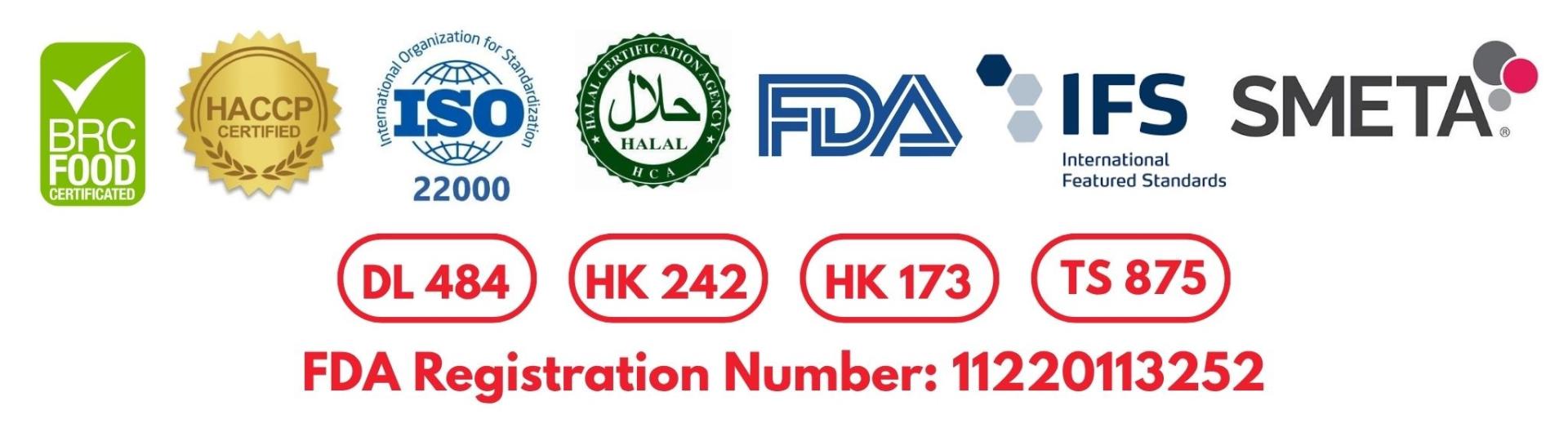
Baseafood is a Vietnamese seafood exporter based in Bà Rịa–Vũng Tàu, specialising in frozen squid, octopus, cuttlefish, frozen fish, dried seafood, and surimi. Our facilities are certified to HACCP, BRC, IFS, ISO 22000, SMETA, HALAL, and FDA standards, and we process cephalopods across the full product range — from whole round and whole cleaned to tube, ring, tentacle, and value-added cuts — under a single, traceable source.
That single-source model is precisely what the CATCH era rewards: complete catch documentation, consistent certification, and one accountable partner across your entire cephalopod range.
“Request a quote and sample documentation”
FAQ
Is the EU CATCH system mandatory in 2026?
Yes. CATCH became compulsory on 10 January 2026 for all fishery-product imports into the EU. Importers must submit catch certificates and related documents digitally through the system in TRACES NT; standalone paper certificates are no longer sufficient.
Do squid and octopus imports need a catch certificate?
Yes. Squid, octopus, and cuttlefish are wild-caught species covered by the EU IUU Regulation, so every commercial consignment entering the EU needs a valid catch certificate — and a processing statement if the product was processed outside the EU.
What is the difference between a catch certificate and a processing statement?
A catch certificate proves the seafood was legally harvested and identifies the harvesting vessel. A processing statement (Annex IV 14.2) is required when wild-caught product is processed in a non-EU country and links the processed goods back to the original catch certificate.
How does Vietnam's IUU "yellow card" affect importers?
The yellow card means EU authorities apply extra scrutiny to Vietnamese wild-caught seafood documentation. It does not ban imports, but it raises the importance of sourcing from exporters with robust traceability. Vietnam has run intensive 2026 compliance programmes aimed at removing the card.
What happens if my catch documentation is incomplete?
An incomplete or invalid CATCH entry can lead to customs holds, rejection or return of the consignment, financial penalties, and an inability to clear customs until the paperwork is corrected — costs that fall on the importer.
Conclusion
The 2026 shift to mandatory digital catch documentation has made supplier choice inseparable from customs risk. For squid and octopus buyers, the safest path is a certified, single-source exporter that can produce complete, first-time-right documentation for every lot.
Baseafood supplies squid, octopus, and cuttlefish across the full product range, backed by HACCP, BRC, IFS, ISO 22000, SMETA, HALAL, and FDA certification. Contact us for a quote and to review our catch documentation format.

