Seafood Sourcing in 2026: Tariffs & Trade Shifts Guide
How 2026 Tariffs and Trade Shifts Are Reshaping Seafood Sourcing
Key takeaways
- US Section 301 tariffs now stack on top of existing duties, adding 10–12.5% to shrimp and other species from major exporting countries — and they are no longer temporary.
- The US Supreme Court let the Section 301 China tariffs stand in June 2026, and lawmakers have requested a broad seafood-wide Section 301 investigation — signalling more, not fewer, trade barriers ahead.
- Trade flows are redirecting toward Asia. China and Hong Kong are now the top destination for Vietnamese seafood, while US demand has flattened.
- For importers, the winning response is diversifying origins, prioritising traceable and certified supply, and planning for price volatility rather than chasing the lowest headline price.
Trade policy — not demand — is now the biggest variable in seafood sourcing. In 2026, a wave of tariffs, legal rulings, and new investigations has changed the cost math for buyers in the US and Europe, and pushed global supply toward new markets. This guide explains what changed, how trade is shifting, and what a resilient sourcing strategy looks like now.
What is Section 301? (Quick definition)
Section 301 is a US trade law that lets the Office of the US Trade Representative (USTR) impose tariffs on imports from countries it finds are engaging in unfair trade practices. Unlike temporary or reciprocal measures, Section 301 tariffs are durable — and in 2026 they became a central tool for raising duties on seafood.
The critical point for importers: these tariffs stack. A Section 301 duty is added on top of the normal tariff rate, any antidumping and countervailing duties (AD/CVD) already in place, and older China-specific tariffs. For some importers, the combined effect has more than doubled their annual duty bill.
What changed in 2026: the new seafood tariff landscape
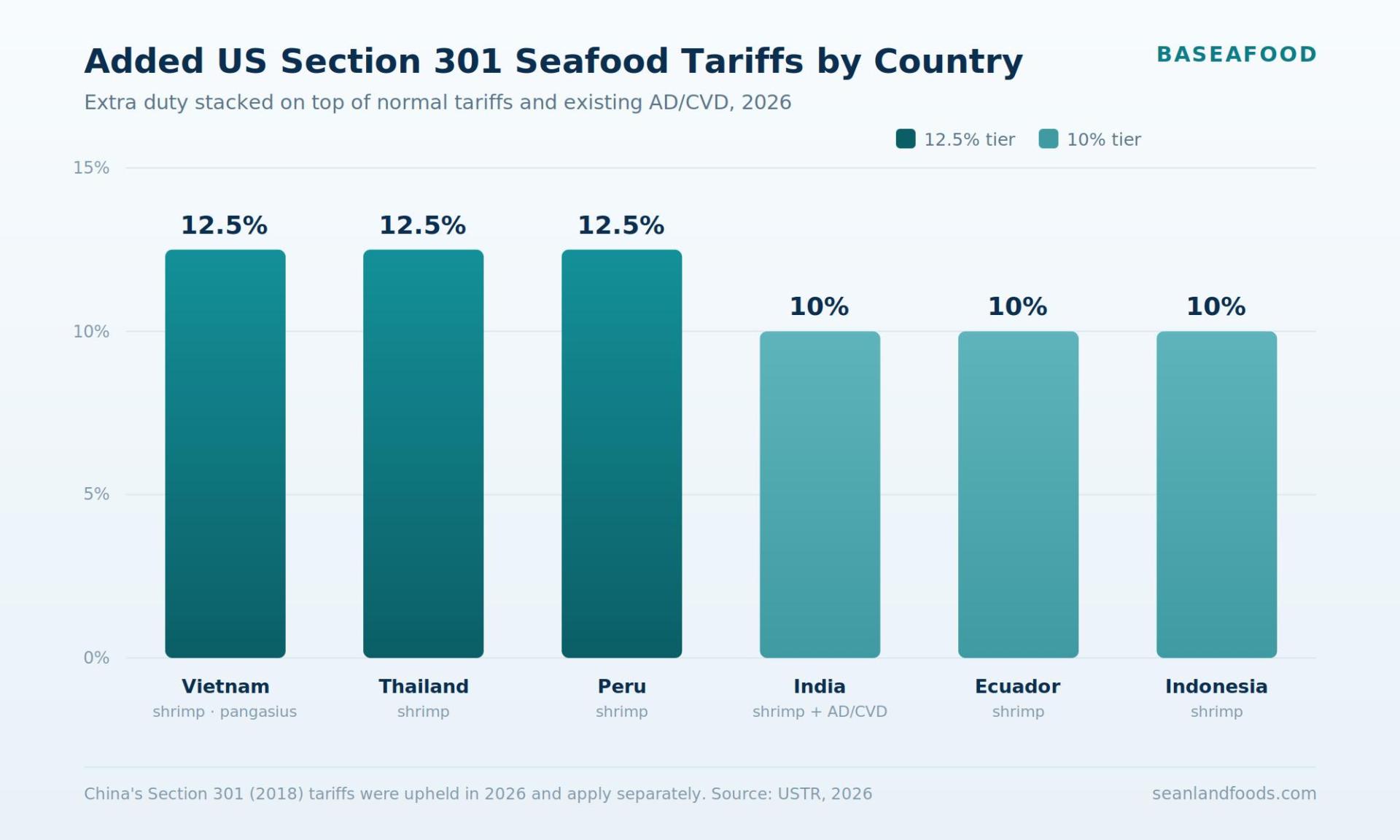
Several developments reshaped the cost of importing seafood into the US this year.
- Section 301 tariffs on key exporters. New duties added 10–12.5% to shrimp and other species from the world's largest producing nations, with limited room for importers to avoid the cost.
- The Supreme Court upheld the framework. In June 2026, the US Supreme Court declined to hear a challenge to the Section 301 tariffs first imposed on Chinese goods in 2018 — ending years of legal uncertainty and making them permanent.
- A seafood-wide investigation was requested. In May 2026, a group of US lawmakers asked USTR to open a broad Section 301 investigation into seafood trade practices — a category worth more than US$26 billion in annual imports. Two related investigations had already launched earlier in the year.
- Antidumping relief for some, uncertainty for all. A US administrative review sharply cut the general antidumping rate on Vietnamese shrimp (to as low as 4.58% for eligible exporters), improving competitiveness — but repeated swings in duty rates have left US importers with a lasting "uncertainty premium" in how they buy.
Tariff snapshot (2026)
| Origin | Added Section 301 tariff | Notes |
|---|---|---|
| Vietnam | 12.5% | Stacks on existing AD/CVD; hits shrimp and pangasius |
| Thailand | 12.5% | Shrimp |
| Peru | 12.5% | Shrimp |
| India | 10% | Plus existing shrimp AD/CVD |
| Ecuador | 10% | Shrimp |
| Indonesia | 10% | Shrimp |
| China | Section 301 (upheld 2026) | Tilapia and others; stacks on AD orders |
These rates are added on top of normal tariffs and any existing AD/CVD duties.
How trade flows are shifting
Tariffs don't just raise costs — they reroute supply. The clearest sign in 2026 is where Vietnamese seafood is actually going.
- Asia is pulling volume east. China and Hong Kong became the largest destination for Vietnamese seafood, with exports up more than 33% year on year and around a quarter of the total, while exports to the US flattened.
- Buyers are reconfiguring sourcing. Industry analysts note that geopolitical pressure has prompted importers to rethink where they buy — spreading risk across more origins rather than concentrating on one.
- New markets are opening. Vietnamese exporters are actively developing destinations such as Brazil, wider South America, and South Asia to reduce dependence on traditional Western markets.
The takeaway for buyers: the map of "cheap and easy" seafood sourcing is being redrawn, and the origins that looked lowest-cost on paper may carry the highest tariff and compliance risk.
What it means for importers: building a resilient sourcing strategy
The importers weathering 2026 best share a common playbook.
1. Diversify origin countries
Concentrating volume in one country exposes you to a single tariff decision. Spreading orders across several qualified origins turns a policy shock into a manageable adjustment rather than a crisis.
2. Prioritise traceability and certification
Tighter trade controls reward suppliers with airtight documentation and recognised certifications. This is doubly true for the EU, where every wild-caught consignment now needs complete catch documentation — see our guide on “EU CATCH and IUU documentation requirements”.
3. Plan for price volatility
Lock pricing assumptions where you can, buy forward ahead of known effective dates, and build the "uncertainty premium" into your cost models rather than waiting for it to disappear.
4. Look at less tariff-exposed categories and markets
Not every species carries the same trade risk. Categories oriented toward Asian and European buyers — rather than the tariff-heavy US shrimp trade — can offer more stable sourcing.
Where wild-caught cephalopods fit
Squid, octopus, and cuttlefish illustrate the diversification logic well. These wild-caught categories are overwhelmingly oriented toward Asian and European buyers — Korea, Japan, China, and ASEAN — rather than the US shrimp market that most tariff action targets. That makes them comparatively insulated from US shrimp-focused duties, while still growing on genuine Asian demand.
For a full breakdown of the market, top destinations, and product formats, see our pillar guide: “Vietnam squid and octopus exports: a sourcing guide for importers”.
Baseafood, a Vietnamese exporter based in Bà Rịa–Vũng Tàu, supplies squid, octopus, cuttlefish, frozen fish, dried seafood, and surimi under HACCP, BRC, IFS, ISO 22000, SMETA, HALAL, and FDA certification — a single, traceable source built for exactly the compliance and diversification pressures 2026 has created. “Talk to us about your sourcing needs”.
Outlook
Trade-policy volatility is likely to remain the defining feature of seafood sourcing into 2027. With Section 301 now entrenched and a broad seafood investigation on the table, importers should expect further shifts rather than a return to the pre-tariff status quo. The buyers who build diversified, well-documented supply chains now will be the ones best positioned when the next policy change lands.
FAQ
What are Section 301 tariffs on seafood?
Section 301 tariffs are US duties imposed by USTR on imports from countries found to use unfair trade practices. In 2026 they added roughly 10–12.5% to shrimp and other seafood from major exporting nations, stacking on top of normal tariffs and existing antidumping and countervailing duties.
Are the US seafood tariffs permanent?
The Section 301 tariffs originally imposed on Chinese goods became effectively permanent after the US Supreme Court declined to hear a challenge to them in June 2026. Additional seafood-specific measures are under consideration, so importers should plan for a lasting higher-tariff environment.
How are tariffs changing global seafood trade flows?
Tariffs are redirecting supply toward Asia. China and Hong Kong became the top destination for Vietnamese seafood in 2026, growing more than 33% year on year, while US demand flattened. Exporters are also developing new markets such as Brazil and South Asia.
How can seafood importers reduce tariff risk?
Diversify your origin countries, prioritise suppliers with strong traceability and certification, lock pricing assumptions and buy forward where possible, and consider categories oriented toward Asian and European rather than tariff-heavy US markets.
Are squid and octopus affected by US shrimp tariffs?
Most 2026 tariff action targets shrimp and a few other species. Squid and octopus are primarily sold to Asian and European buyers, making them comparatively insulated from US shrimp-focused duties — though all wild-caught seafood must still meet destination-market traceability rules.
Conclusion
In 2026, sourcing seafood well means sourcing defensively. Tariffs are stacking, trade flows are moving east, and compliance requirements are tightening. The importers who diversify origins and lock in certified, traceable supply will absorb these shocks far better than those chasing the lowest headline price.
Baseafood offers certified, fully documented squid, octopus, and cuttlefish from Vietnam — a resilient sourcing option for a volatile market. Contact us to discuss your requirements.

